
Before the RFP: How AI Is Quietly Changing the Manufacturing Shortlist


And why technical expertise that is not machine-readable is becoming invisible
Imagine a procurement engineer at a mid-sized OEM.They need a new supplier for custom-machined components. The requirements are clear: ISO 9001 certified, tight-tolerance aluminium, capacity for 50,000 units a month, and a lead time under four weeks.
Five years ago, they would have typed those keywords into Google and worked through five or six supplier websites. They would have opened PDF catalogues, compared capability statements, and slowly built a mental shortlist.
Today, they open ChatGPT, Gemini, Perplexity, or Copilot and type almost the exact same sentence.Within seconds, the system returns three or four suppliers.
This is no longer a minor change in research behaviour. It is a structural shift in when and how the shortlist is formed. The buyer is no longer simply searching for information. They are asking an AI system to help decide which companies are worth considering at all. The competitive evaluation is beginning earlier — often before any formal RFP is issued.
What the machine can (and cannot) see
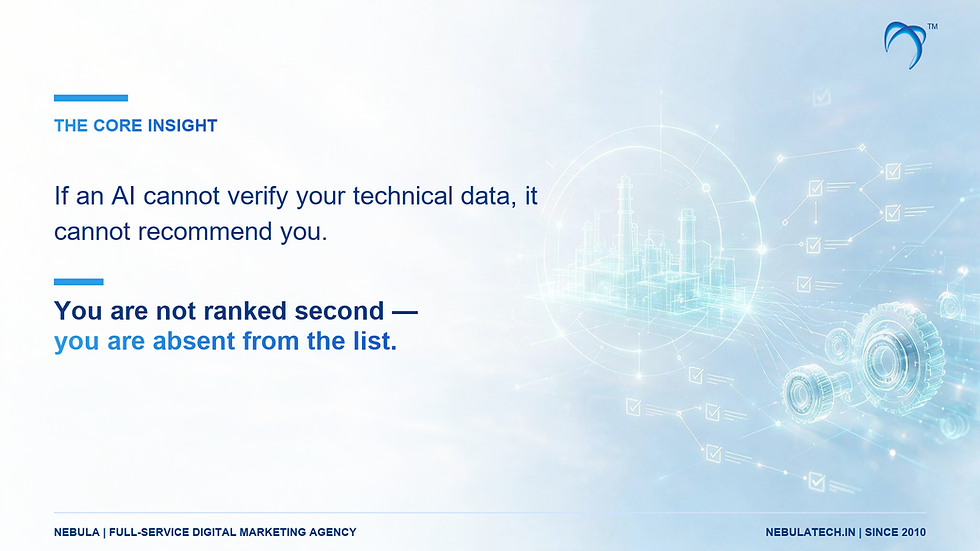
If a company’s technical specifications, compliance certificates, and capability statements remain locked inside PDFs, buried behind contact forms, or expressed only in broad corporate language, an AI system frequently cannot extract or verify them reliably. When the system cannot verify the data, it does not cite the company.
You are not ranked second. You are absent from the list. To understand why this happens, consider how an AI evaluates two otherwise similar manufacturers.
Manufacturer A has decades of engineering experience, sophisticated machinery, and a strong export record. Their website speaks in generalities: “world-class manufacturing,” “advanced technology,” “quality-driven solutions.” The detailed specifications sit inside a forty-page downloadable PDF catalogue.
Manufacturer B has comparable equipment and similar certifications. Their public site states the facts clearly: “CNC milling, 6061-T6 aluminium, tolerances to ±0.005 mm, ISO 9001:2015 certified, 50,000-unit monthly capacity.” Their case studies describe the engineering challenge, the material used, and the measurable outcome.
A human procurement professional can open Manufacturer A’s PDF and understand it in thirty seconds.An AI system scanning hundreds of potential suppliers in the same window cannot reliably extract and cross-reference that PDF data at scale. It defaults to Manufacturer B — not because Manufacturer B has better machines or lower prices, but because its technical authority is legible. The system can verify the claims and synthesise them into an answer.
This difference in legibility is beginning to determine who enters the early conversation.
Why this shift matters more in manufacturing
Manufacturing, EPC, and industrial export cycles are long. Multiple stakeholders are involved. Technical teams evaluate capability. Procurement assesses commercial viability. Quality examines compliance. Leadership weighs risk.
By the time a formal sales conversation begins, a significant amount of research has often already taken place. Increasingly, some of that early research is assisted by AI tools. These systems do not replace the procurement team. They influence which companies appear on the team’s radar in the first place.
That is a quieter, more structural change than most marketing discussions acknowledge.
Traditional marketing spend tends to depreciate quickly. Visibility that compounds — the kind that makes expertise discoverable inside the tools buyers now use — is different. It places a company where modern B2B decisions increasingly begin: inside the AI answer layer.
The real organisational friction
In conversations with manufacturing leaders, we often hear the same observation: “We have all this technical data. It is just not organised for the web.”
That is the core issue.
Most manufacturers have spent decades building deep technical expertise. They hold engineering drawings, material specifications, tolerance data, compliance certifications, and case studies. But this knowledge lives in disconnected places — PDFs, internal databases, sales decks, engineering notebooks, and the experience of senior staff.
Making this knowledge publicly discoverable is not primarily a marketing task. It is an organisational one.
It requires deciding which capabilities are strategic enough to publish in detail. It requires engineering and technical teams to help translate knowledge into structured, machine-readable content. It requires marketing teams to move from generic claims (“world-class solutions”) to precise statements (“CNC milling, 6061-T6 aluminium, tolerances to ±0.005 mm”).
And it requires leadership to recognise that this is not about being louder. It is about being clearer, more structured, and more precise about what the company actually does.
That can feel uncomfortable. It means making specific capabilities visible rather than keeping them behind broad language. But it also means that buyers — and the AI systems they increasingly rely on — can verify that the capability exists.
What companies appearing in AI shortlists are doing differently
From our work with manufacturers and exporters over the last several years, the firms that are starting to surface in AI-generated recommendations share a few consistent habits.
They treat their most important capability statements, material data, tolerance ranges, and compliance certifications as public, structured content rather than files that require a request to access.
They write case studies in the language buyers actually use when prompting AI tools — stating the problem, the material, the tolerance achieved, the volume, and the outcome with precision.
They periodically test their own visibility by asking the same systems their customers use:
“Who are the strongest suppliers for this specific capability in this region?”
“Which manufacturers can produce high-volume aluminium components with tight tolerances and international certifications?”
The answers are often more revealing than conventional marketing dashboards. They show, quite directly, whether a company’s expertise is actually discoverable when a potential buyer is looking for it.
None of this requires abandoning traditional SEO. It requires recognising that the nature of discovery itself is changing. The objective is expanding beyond ranking pages toward building a digital knowledge base that search engines, AI systems, and human decision-makers can understand and trust.
Technical knowledge as a strategic digital asset
For manufacturers, this means treating technical knowledge as a strategic digital asset.
Engineering drawings, product specifications, certifications, application expertise, manufacturing capabilities, case studies, and decades of accumulated experience should not remain disconnected pieces of corporate information. They need to form a coherent, publicly discoverable body of evidence about what the company can actually do.
This is the work of Generative Engine Optimization (GEO) and broader AI visibility: structuring a brand’s digital presence so that AI systems can accurately understand, verify, and cite it when buyers ask for recommendations.
Since 2010 we have helped manufacturers and exporters adapt through successive shifts in how buyers discover suppliers — from early directory listings and classic SEO, through content and social channels, to the current move toward AI-assisted research. Each stage changed the rules of visibility. This one is changing who gets considered before a conversation even begins.
In 2026, one of the more consequential competitive advantages in B2B manufacturing may not be the newest machine or the lowest quote. It may be whose technical expertise is most clearly machine-readable — and therefore most likely to be recommended inside the tools that are quietly shaping the market.
Decades of real manufacturing capability deserve to be visible in the places where decisions now start.
The RFP will still matter.But increasingly, the shortlist is being formed before it arrives.
A practical next step
If you would like to understand how AI systems currently perceive your company’s capabilities, we offer a complimentary AI-SEO Readiness Snapshot. We prompt leading AI engines with queries relevant to your niche and show you where your brand stands — and where the gaps are.
FAQs:
Does AI really influence B2B manufacturing shortlists?
Yes. Procurement and technical teams increasingly use AI tools for early vendor research. These systems help form the initial shortlist before formal RFPs or sales conversations begin.
Why can’t AI read our existing PDF catalogues and certifications?
Most AI systems struggle to reliably extract and verify detailed technical data from PDFs, scanned documents, or content locked behind forms at scale. Structured, publicly available HTML content is far more legible.
Is this different from traditional SEO?
Traditional SEO helps pages rank in search results. Generative Engine Optimization (GEO) focuses on making your expertise clear and citable inside AI-generated answers. Both matter; they solve different parts of the visibility problem.
What should manufacturers do first?
Start by making core capability statements, material specifications, tolerance data, and key certifications available as clean, structured content on the website. Then test how AI tools currently describe your company for relevant buyer queries.
How does Nebula help with this?
We help manufacturers and exporters structure technical knowledge for AI visibility through our GEO framework, including content architecture, entity signals, and ongoing AI-search readiness reviews.


