
GEO in 2026: How to Get Your Brand Into AI-Generated Answers

An AI-First Digital Marketing Agency specializing in AI SEO, International SEO, LinkedIn Thought Leadership, and AI-ready content strategies that help businesses increase visibility, build trust, and accelerate growth.
Published: July 2026 | Last Reviewed: July 2026
TL;DR — If You Read Nothing Else, Read This
Ranking is not enough. AI systems — ChatGPT, Google AI Overviews, Copilot, Gemini, Perplexity — generate direct answers. They cite a small number of authoritative sources. If you are not one of them, the buyer never reaches your website.
GEO is a distinct discipline. Generative Engine Optimisation (GEO) is the practice of structuring your content, authority signals, and digital presence so that AI models choose to reference and recommend your brand when answering relevant queries.
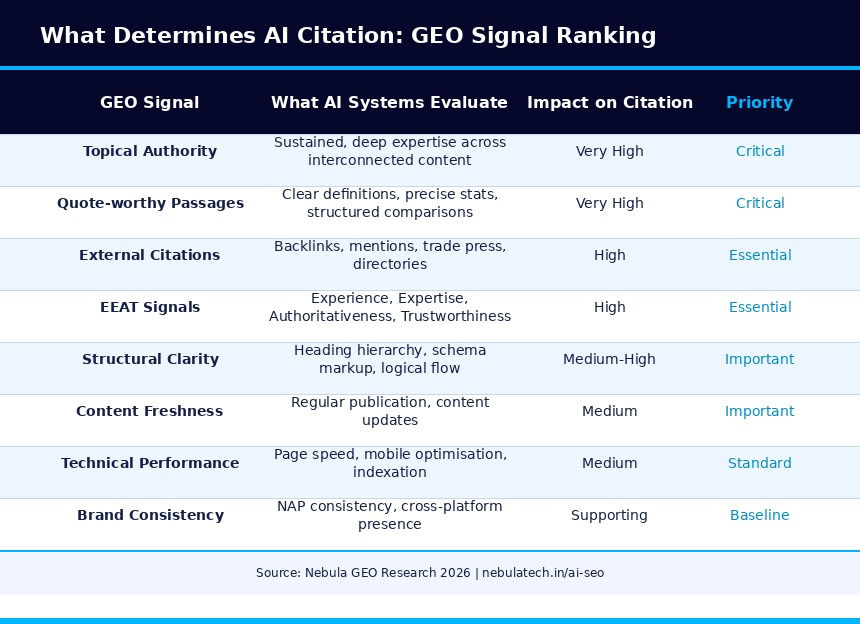
Three things determine who gets cited: depth of topical authority, the presence of quote-worthy passages, and external validation signals (citations, mentions, backlinks from credible sources).
Indian B2B companies are underrepresented in AI answers. This is a first-mover opportunity. Brands that build GEO-ready content architectures now will hold compounding citation advantages over competitors who move later.
GEO and SEO are not the same strategy. The content that earns a Google ranking often differs structurally from the content that earns an AI citation. You need both — built on a unified authority foundation.
🎯 Is Your Brand Being Cited by ChatGPT, Copilot, or Google AI Overviews?
Find out in 48 hours — at no cost.
Nebula Personalization Tech Solutions offers a complimentary AI Visibility Audit for Indian B2B companies. We test your brand across ChatGPT, Copilot, Gemini, Perplexity, and Google AI Overviews — and show you exactly where you appear, where you don't, and what to fix first.
No obligation. No sales pitch. Just a clear picture of your GEO and AI search presence.
The Moment the Rules Changed
On 14 May 2024, Google deployed AI Overviews to the United States at scale — placing AI-generated summaries above every organic search result for millions of queries. Within months, the rollout extended to India, the UK, Japan, and over 100 additional markets.
The implication was immediate, measurable, and irreversible.
For queries where AI Overviews appear, the content above the fold is no longer a list of ten blue links. It is a synthesised, AI-generated answer — drawing from sources Google's systems have identified as authoritative, accurate, and well-structured. The websites those answers cite receive visibility, credibility, and traffic. The websites that are not cited are invisible at the moment that matters most.
This is not a Google-specific phenomenon. Microsoft Copilot generates cited answers across enterprise workflows. ChatGPT cites web sources in its browsing-enabled mode. Perplexity cites sources by default on every query. Claude cites sources. Gemini cites sources.
The pattern is consistent: AI systems generate answers and attribute them to sources. A small number of brands get cited. The rest do not.
Generative Engine Optimisation — GEO — is the discipline of ensuring your brand belongs among those that get cited.
For Indian businesses, particularly those operating in B2B sectors, the window to establish first-mover citation authority is open right now. The companies that move in 2026 will be far ahead of those that move in 2027.
What Is GEO?
Generative Engine Optimisation (GEO) is the practice of optimising a business's content, authority signals, and digital presence so that AI-powered generative search systems — including ChatGPT, Google AI Overviews, Microsoft Copilot, Gemini, and Perplexity — select it as a cited source when generating answers to relevant queries.
GEO is not a rebranding of SEO. It is a distinct discipline with different success criteria, different content requirements, and different measurement frameworks.
The objective of traditional SEO is ranking — appearing on the first page of search results for target keywords.
The objective of GEO is citation — being selected by AI systems as a reference when they generate answers to questions your target buyers are asking.
A business can rank on page one of Google for a competitive keyword and never appear in a single AI-generated answer. Conversely, a business with strong GEO foundations may be prominently cited across ChatGPT, Copilot, and Perplexity — even without holding the top organic position.
Both outcomes are increasingly common. Both demand intentional strategy.
How AI Systems Decide What to Cite
Understanding GEO begins with understanding how generative AI models select their sources.
AI language models are trained on vast bodies of text from across the internet. During that training, they develop representations of which sources tend to be accurate, consistent, authoritative, and well-structured. These representations — sometimes described as entity associations — influence which sources the model favours when generating answers.
For real-time citation (as used by ChatGPT Browse, Perplexity, Copilot, and Google AI Overviews), AI systems retrieve content from the web and evaluate it against several dimensions before deciding whether to cite it.
Topical depth and consistency — Does this source demonstrate sustained, deep expertise on the subject? A single blog post rarely earns citation. A website with a well-developed content cluster — multiple interconnected, in-depth articles on a topic — signals genuine authority.
Quote-worthy passages — AI systems seek content that can be directly incorporated into a generated answer. Clear definitions, precise statistics, structured comparisons, and concise expert summaries are far more likely to be cited than vague, hedged, or generic content.
External validation — Backlinks from credible sources, mentions in industry publications, references in research reports, and citations in authoritative directories all signal to AI systems that a source is trusted by others in the field.
Structural clarity — Content that is well-organised with clear headings, logical flow, schema markup, and factual precision is easier for AI retrieval systems to parse, evaluate, and incorporate into generated answers.
Google E-E-A-T alignment — Google's framework of Experience, Expertise, Authoritativeness, and Trustworthiness is not limited to ranking algorithms. The same signals that strengthen Google E-E-A-T also improve GEO performance. Content demonstrating real practitioner experience, original analysis, and transparent authorship is preferred by AI systems over anonymously published, surface-level content.
🔍 Want to know how AI systems currently perceive your brand? Nebula Personalization Tech Solutions runs AI citation audits for Indian B2B companies across ChatGPT, Copilot, Perplexity, and Google AI Overviews. Request your free audit →
Why Indian B2B Companies Are Underrepresented in AI Answers
When Indian buyers ask ChatGPT to recommend a B2B software vendor, a digital marketing agency, an engineering supplier, or a pharmaceutical manufacturer — the answers generated today are dominated by Western brands, generic directories, and large global platforms.
This is not because Indian businesses lack expertise or quality. It is because the structural conditions for AI citation — consistent topical authority, structured content, external mentions in credible publications, and a well-developed digital footprint — are less commonly built by Indian businesses than by their global counterparts.
This creates a significant first-mover opportunity.
Indian companies that invest in GEO-optimised content architectures in 2026 will establish citation authority that compounds over time. As AI systems continue to favour sources with proven authority track records, early movers will accumulate citation advantages that late entrants find increasingly difficult to displace.
This is particularly relevant for Indian businesses targeting international buyers — exporters, manufacturers, pharmaceutical companies, software vendors, and professional services firms seeking clients in the US, UK, EU, Middle East, and Southeast Asia. When international buyers use AI-assisted research to identify Indian suppliers, GEO-ready businesses will appear in those answers. Others will not.
GEO vs SEO: Understanding the Distinction
The most common mistake businesses make when first learning about GEO is assuming that strong SEO automatically delivers GEO performance. It does not — though the two disciplines share an important foundation.
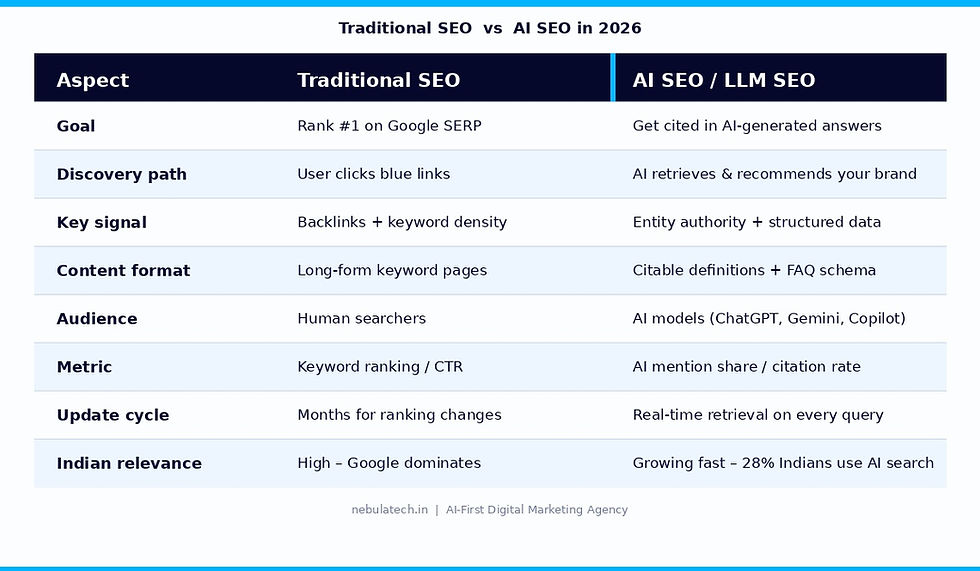
The key insight is this: SEO optimises for ranking signals. GEO optimises for citation signals. These overlap significantly at the level of authority, technical structure, and content quality — but diverge at the level of content format, specificity, and topical depth.
A 500-word blog post optimised for a single keyword may rank well for that keyword. It is unlikely to be cited by an AI system generating a comprehensive answer on the same topic.
A 2,500-word pillar article demonstrating deep expertise, offering original analysis, containing precise definitions, and earning citations from credible external sources will underperform a keyword-optimised article in narrow ranking contests — but will significantly outperform it in AI citation rate.
Indian businesses need both. The practical path forward is to build a unified content authority architecture that serves both SEO and GEO objectives — investing in long-form, expert-led content that ranks and gets cited.
The GEO Content Framework for Indian Businesses
Pillar 1: Own a Topic, Not Just a Keyword
GEO requires topical ownership. AI systems do not cite sources that know a little about many things. They cite sources that demonstrate sustained, deep expertise on a specific domain.
For an Indian digital marketing agency, that domain might be AI SEO and B2B content strategy for Indian manufacturers and exporters. For an Indian pharmaceutical manufacturer, it might be API synthesis, regulatory compliance, and pharmaceutical export logistics. For an engineering company, it might be pressure vessel design, industrial automation, or engineering procurement and construction.
The starting point is identifying the topic cluster your business genuinely has the depth to own — and then building a comprehensive, interconnected content architecture around it.
For Nebula Personalization Tech Solutions, that cluster encompasses AI SEO, GEO, AEO, SEO for Indian businesses, content strategy, and LinkedIn marketing — all connected through consistent internal linking and a unified authority signal.
Pillar 2: Write Content That AI Can Quote
AI citation is fundamentally a quoting behaviour. When an AI system generates an answer, it is looking for passages it can incorporate — either verbatim or in close paraphrase — into a coherent response.
This has direct implications for content structure:
Lead with a citable definition. Every article should open with a clear, precise, original definition of the primary concept. This is the passage most likely to be cited when AI systems answer "What is GEO?" or "What is generative engine optimisation?"
Include statistical anchors. Specific data points — even where sourced from credible third parties with attribution — significantly increase citation rate. "Over 28% of Indian consumers now use AI-assisted search" is more citable than "many Indian consumers use AI search."
Write structured comparisons. Comparisons and distinctions — "GEO vs SEO", "AI SEO vs traditional SEO", "ChatGPT vs Google AI Overviews" — are among the most-cited content formats in AI-generated answers.
Embed expert summaries. Concise, authoritative summaries of complex topics — written at practitioner level, not general-audience level — are highly citable. AI systems are looking for content that sounds like it was written by someone who genuinely knows the subject.
Pillar 3: Earn External Citations
Your own website is not sufficient evidence of your authority. AI systems weight external validation heavily — because any website can claim expertise, but external citations from credible sources are harder to manufacture.
For Indian businesses, the most accessible high-value citation sources include:
Industry publications — Contributing articles, guest columns, or expert commentary to trade publications in your sector builds the external citation footprint that AI systems recognise.
Business media — Coverage in Economic Times, Business Standard, Mint, YourStory, Inc42, and sector-specific trade journals generates external mentions that strengthen AI citation authority.
Research reports and whitepapers — Being cited in industry research — even as a data source or expert voice — creates the kind of credible external reference that AI systems prioritise.
Directories and association listings — Clutch, G2, NASSCOM member listings, CII membership, industry association profiles, and Google Business Profile all contribute to the external authority footprint.
LinkedIn articles and newsletters — LinkedIn content indexed by search engines creates additional citation surface area, particularly for B2B expertise topics where LinkedIn is a credible source.
Pillar 4: Structure Content for AI Retrieval
Well-structured content is easier for AI systems to parse, evaluate, and incorporate into generated answers. This means:
Logical heading hierarchy using H2 and H3 tags — not arbitrary heading levels that confuse retrieval systems.
Schema markup — Article, FAQPage, HowTo, and Organisation schema help AI systems understand the nature, purpose, and author of your content.
Clean internal linking — A well-linked content cluster creates semantic relationships between articles that help AI systems understand the depth and coherence of your topical authority.
Fast page loading and mobile optimisation — Technical performance signals remain relevant; AI retrieval systems favour content that is reliably accessible.
Pillar 5: Demonstrate Consistent Publishing Cadence
A single excellent article is insufficient for sustained GEO performance. AI systems favour sources that demonstrate ongoing engagement with a topic — consistent publication, regular updates to existing content, and a growing body of interconnected work.
For Indian businesses, a sustainable GEO content cadence typically means one to two substantive, expert-led articles per week — supported by regular refreshes of service pages, case studies, and key pillar content.
📝 Need expert-led GEO content for your business? Nebula Personalization Tech Solutions' content marketing team develops AI-citation-ready pillar content, topic clusters, and editorial calendars for Indian B2B companies. Explore our AI-First Search Marketing Services →
GEO for Specific Indian Business Sectors
Manufacturing and Engineering Exporters
Indian manufacturers and engineering companies targeting international buyers face a specific GEO challenge: their buyers — procurement officers, EPC contractors, project managers — are increasingly using AI-assisted research to identify and shortlist suppliers.
A GEO strategy for Indian manufacturers should include: detailed technical content on products, processes, and specifications; export market content addressing buyer concerns in target regions; case studies from actual project engagements; and external citations from trade associations, export promotion councils, and industry directories.
Pharmaceutical and Nutraceutical Companies
Indian pharmaceutical exporters, API manufacturers, and nutraceutical brands operate in a compliance-intensive environment where content must balance authority-building with regulatory responsibility. A GEO strategy for this sector should include: regulatory expertise content; quality and certification content; export market intelligence; and third-party citations from industry bodies including PHARMEXCIL, FIEO, and healthcare publications.
B2B Professional Services
Indian consulting firms, digital agencies, IT service providers, and professional services organisations have among the strongest GEO opportunities — because their buyers rely heavily on AI-assisted research when evaluating vendors. Content demonstrating genuine client outcomes, sector-specific expertise, and original methodological frameworks is particularly effective for GEO in this sector.
Local and Regional Businesses
For businesses serving specific Indian cities and regions, GEO works alongside local SEO. Content that addresses specific local business contexts — "AI SEO for Mumbai manufacturers", "digital marketing for Pune exporters", "LinkedIn strategy for Navi Mumbai professional services firms" — creates geographic specificity that both local search algorithms and AI systems recognise.
Measuring GEO Performance
GEO measurement is an evolving field. Unlike SEO — where ranking position provides a clear, measurable metric — GEO performance requires a combination of direct testing, brand mention monitoring, and proxy metrics.
Direct AI query testing — Regularly test queries relevant to your business across ChatGPT, Perplexity, Copilot, and Google AI Overviews. Document when and how your brand, content, or website is cited. Track changes over time as you build GEO-optimised content.
Brand mention monitoring — Tools that track brand mentions across the web provide a proxy for the external citation footprint that drives GEO performance. Growing external mentions from credible sources is a leading indicator of improving GEO visibility.
Referral traffic from AI platforms — Google Analytics and other analytics platforms increasingly show traffic from AI-assisted sources. Growth in referral traffic from Perplexity, ChatGPT, and similar platforms is a direct GEO performance signal.
Content indexation and citation tracking — Monitor which of your articles appear in AI-generated answers through systematic query testing. Track changes in citation rate as you improve content quality, external authority, and topical depth.


The GEO Implementation Roadmap
Months 1–2: Foundation Audit your existing content for GEO readiness — identify which articles have the depth, structure, and external citation potential to earn AI references. Refresh key existing content to add citable definitions, statistical anchors, and structured comparisons. Begin building the external citation footprint through industry publication contributions and business directory listings.
Months 3–4: Authority Building Publish your first complete topic cluster — interconnected pillar and cluster content that demonstrates deep, coherent expertise on your primary subject area. Implement schema markup across your highest-value content. Begin systematic GEO testing across AI platforms.
Months 5–6: Citation Acceleration Target external citation from credible industry publications, research reports, and authoritative directories. Develop content partnerships that generate inbound links and mentions from recognised sources. Expand the topic cluster to cover adjacent subjects, increasing the surface area across which AI systems can cite your brand.
Months 7–12: Compounding Authority At this stage, well-executed GEO strategy begins to deliver compounding returns. Citation authority builds on itself: AI systems that cite your content generate additional mentions, which generate additional authority signals, which increase future citation rate. Continue consistent publication, monitor GEO metrics closely, and expand into adjacent topic areas where your expertise is credible.
Client Success Stories
The following case studies have been anonymised to protect client confidentiality. Results vary based on industry, competition, website maturity, and implementation.
Case Study 1: Industrial Manufacturer Achieves AI Citation in International Markets
Industry: Engineering and Industrial Equipment | Location: Mumbai Metropolitan Region
Following a structured GEO content programme developed by Nebula Personalization Tech Solutions, the company's website began appearing as a cited source in AI-generated responses to queries about industrial equipment specifications in international markets. The programme included the development of detailed technical content, export-market-specific articles, and a targeted external citation strategy through industry publications and trade association listings.
Case Study 2: Professional Services Firm Cited in AI Recommendations
Industry: B2B Professional Services | Location: Navi Mumbai
After developing a comprehensive topic cluster and contributing to industry publications with Nebula Personalization Tech Solutions, the firm began appearing in AI-generated answers to queries about professional services categories they serve. The citation pattern was initially observed in Perplexity, followed by increased visibility in ChatGPT Browse mode, and subsequently in Google AI Overviews.
Case Study 3: Digital Agency Builds GEO Authority in Target Categories
Industry: Digital Marketing Services | Location: Mumbai
A structured GEO programme combining pillar content, external media contributions, and systematic AI query monitoring resulted in the agency appearing in AI-generated answers to multiple high-value queries within their service categories within six months of programme initiation.
Ready to Appear in AI-Generated Answers?
Nebula Personalization Tech Solutions builds GEO and AI SEO programmes for Indian MSMEs, SMBs, and enterprises across manufacturing, pharma, engineering, and B2B services.
Our AI-first content strategies are built on what actually works for Indian businesses targeting domestic and international markets.
How Nebula Personalization Tech Solutions Builds GEO Authority for Indian Businesses
At Nebula Personalization Tech Solutions, GEO is a core component of every AI-first digital marketing programme we develop. Our approach integrates AI SEO and GEO within a unified content authority architecture — because the two disciplines share foundational requirements even as they diverge in execution.
GEO Content Strategy — We develop topic cluster architectures, pillar content frameworks, and editorial calendars specifically designed to build AI citation authority in your sector. Every piece of content is structured for both search ranking and AI retrieval.
Content Marketing — Our content team produces expert-led, deeply researched articles, whitepapers, and case studies that meet the depth, precision, and structure requirements for AI citation. We write content that practitioners recognise as credible — because it is written by practitioners.
External Citation Building — We develop media and publication strategies that build the external mention footprint AI systems rely on when evaluating source authority. This includes industry publication contributions, business media outreach, trade association engagement, and strategic directory management.
SEO Foundation — Technical SEO, site architecture, schema markup, and internal linking all contribute to GEO performance. We ensure the technical foundation supports both ranking and citation objectives.
LinkedIn Marketing — Executive and organisational LinkedIn presence generates additional external authority signals, particularly valuable for B2B GEO in sectors where individual expertise is a key differentiator.
GEO Performance Monitoring — We track AI citation performance across ChatGPT, Perplexity, Copilot, Gemini, and Google AI Overviews — providing clients with clear visibility into how their GEO investment is performing.
Frequently Asked Questions
What is GEO — Generative Engine Optimisation?
Generative Engine Optimisation (GEO) is the practice of optimising a business's content, authority signals, and digital presence so that AI-powered generative search systems — including ChatGPT, Google AI Overviews, Microsoft Copilot, Gemini, and Perplexity — select it as a cited source when generating answers to relevant queries. Unlike traditional SEO, which targets search engine rankings, GEO targets AI citation — the selection of your brand, content, or website as a reference source inside an AI-generated answer.
How is GEO different from traditional SEO?
Traditional SEO focuses on ranking signals — keywords, backlinks, technical structure, and page authority — with the goal of appearing on the first page of search results. GEO focuses on citation signals — topical depth, quote-worthy content, external validation, and Google E-E-A-T alignment — with the goal of being cited inside AI-generated answers. The two disciplines share an authority foundation but diverge in content format, specificity, and measurement. Indian businesses need both, built on a unified content strategy.
How long does GEO take to deliver results for Indian businesses?
The first AI citations — particularly in Perplexity and ChatGPT Browse — can appear within three to six months of a structured GEO content programme for businesses with an existing, moderately developed online presence. More consistent citation visibility across Google AI Overviews and Copilot typically develops over six to twelve months. GEO authority compounds over time: earlier movers accumulate citation track records that later entrants find increasingly difficult to displace.
Which AI platforms should Indian businesses prioritise for GEO?
Google AI Overviews should be the primary priority for most Indian businesses — given Google's dominant market share in India across both desktop and mobile search. Perplexity is the most transparent for GEO testing, as it shows citations explicitly. ChatGPT in Browse mode and Microsoft Copilot are increasingly important for B2B audiences. A well-executed GEO strategy — built on genuine topical authority and credible external citations — will improve performance across all platforms simultaneously, as the underlying signals are consistent.
Can a small Indian business compete with large global brands in GEO?
Yes — within specific topic niches. AI systems do not automatically favour large brands over small ones. They favour sources with depth, accuracy, structure, and external validation on specific topics. A small Indian B2B company that builds genuine, deep expertise on a narrowly defined topic — and earns credible external citations in that niche — can outperform much larger competitors in AI citation for relevant queries. This is one of the most significant strategic opportunities GEO presents for Indian MSMEs.
What content format works best for GEO?
Long-form, expert-led articles with clear definitions, precise data points, structured comparisons, FAQ sections, and logical heading architecture perform best for GEO. Content between 2,000 and 4,000 words with original analysis and genuine practitioner insight consistently outperforms shorter, keyword-optimised content in AI citation rate. Content should be written for the practitioner or decision-maker who needs to understand a topic in depth — not for a general audience seeking a surface-level summary.
Is Google E-E-A-T still relevant for GEO?
Google E-E-A-T — Experience, Expertise, Authoritativeness, and Trustworthiness — is more relevant than ever. The signals that build Google E-E-A-T also build GEO performance: demonstrable practitioner experience, genuine domain expertise, external recognition and citation, and factual consistency. AI systems use similar signals to evaluate source quality. Investing in Google E-E-A-T is investing in both SEO and GEO simultaneously.
How should Indian businesses measure GEO performance?
The most direct measurement is systematic query testing across AI platforms — regularly asking the queries your buyers are likely to ask and documenting when your brand or content is cited. Supporting metrics include brand mention growth from credible sources, referral traffic from AI platforms (visible in analytics), and content citation rate tracking. GEO measurement is still evolving; businesses that establish consistent monitoring frameworks now will have valuable performance data as the measurement ecosystem matures.
The Compounding Advantage
GEO authority is not reset every quarter. Unlike paid advertising — where visibility disappears the moment spend stops — GEO citation authority accumulates.
An Indian business that builds a genuinely authoritative topic cluster, earns credible external citations, and demonstrates consistent expertise over twelve months will have established a citation track record that AI systems recognise and reinforce. The brands that move in 2026 will be significantly harder to displace in 2028 than they would have been to challenge in 2026.
This is the compounding logic that makes GEO one of the highest-return long-term digital marketing investments available to Indian businesses today.
🎯 Free AI Visibility Audit — See Exactly Where Your Brand Stands in AI-Generated Answers
Does your business appear when buyers ask ChatGPT, Copilot, or Google AI Overviews for a vendor recommendation in your category?
Nebula Personalization Tech Solutions will test your brand across five AI platforms — ChatGPT, Microsoft Copilot, Google AI Overviews, Gemini, and Perplexity — and deliver a personalised AI Visibility Report within 48 hours.
Your report will show you:
Where your brand currently appears (or doesn't) in AI-generated answers
Which competitors are being cited instead of you
The top 3 GEO actions to improve your AI citation visibility immediately
A 90-day roadmap to build sustainable AI citation authority
No cost. No obligation. Just clarity on where you stand — and where to go next.
Begin Building Your GEO Foundation
The businesses appearing in AI-generated answers today did not get there by accident. They built genuine expertise, published consistently, earned credible external citations, and structured their content for AI retrieval.
Whether your objective is to reach buyers in Mumbai, Navi Mumbai, Pune, or Delhi — or to reach procurement managers in the United States, Europe, the Middle East, or Southeast Asia — a structured GEO programme is one of the most durable competitive advantages available in 2026.
Nebula Personalization Tech Solutions develops integrated AI SEO and GEO programmes for Indian MSMEs, SMBs, and enterprise organisations. Our programmes are built on what actually works — measurable authority building, expert-led content, and systematic citation development.
Get in touch with our team to schedule a GEO strategy consultation and begin building the citation authority that will define your digital visibility over the next three to five years.
© 2026 Nebula Personalization Tech Solutions Private Limited. All rights reserved.
Nebula Editorial Team | info@nebulatech.in | nebulatech.in

